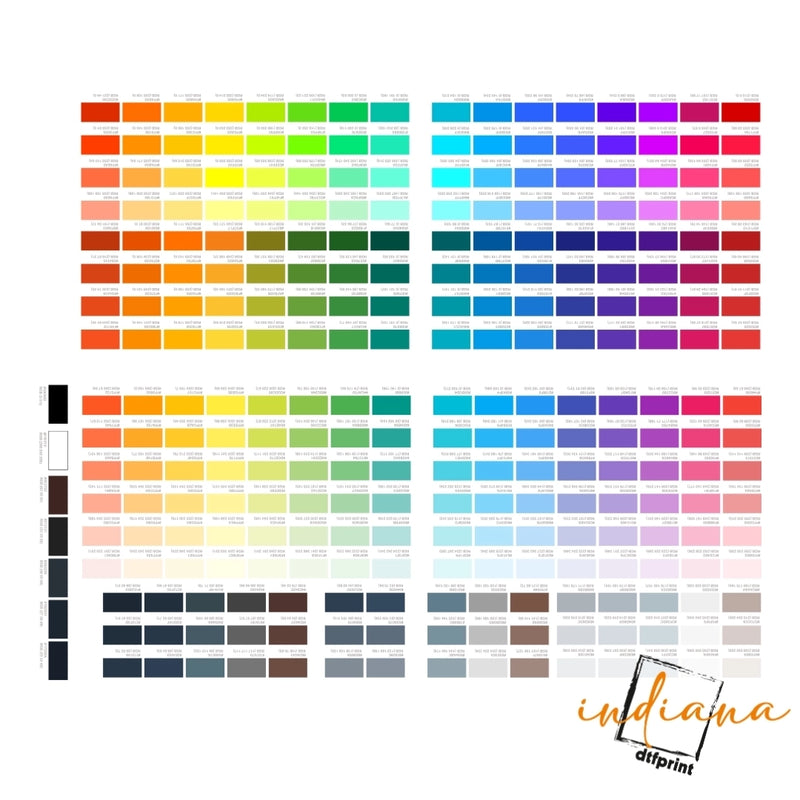
DTF printing supplies are the materials that turn artwork into a finished garment, film, ink, adhesive powder, heat press tools, and the consumables a print shop uses every production day. Indiana DTF Print stocks direct-to-film supplies in Indianapolis for print shops, apparel decorators, clothing brands, side sellers, school and team apparel suppliers, and anyone who prints or presses DTF transfers for shirts, hoodies, uniforms, and merch.
This collection is for buyers who already produce or press orders, not for buyers looking for finished garments. If you need shirts and hoodies with your design already applied, visit the [custom apparel collection → Indiana DTF Print/collections/custom-apparel]. If you need raw DTF transfer sheets to press yourself, visit the [DTF transfers collection → Indiana DTF Print/dtf-transfers]. If you need UV DTF decals for hard goods? Visit the [DTF gang sheets page → Indiana DTF Print/uv-dtf].
Indiana has a strong production base for this category. The SBA Office of Advocacy lists 569,851 small businesses in Indiana in its 2024 profile. STATS Indiana puts the Indianapolis metro at 2,174,599 people across nine counties in 2025. Print shops, apparel decorators, school merch sellers, team wear suppliers, and clothing brands across Indianapolis, Carmel, Fishers, Greenwood, Noblesville, Avon, Brownsburg, Plainfield, Westfield, Lawrence, and Anderson all depend on reliable, locally accessible DTF supplies to keep production moving.
[Shop DTF supplies → Indiana DTF Print/collections/dtf-supplies]
What Are DTF Printing Supplies?
DTF printing supplies are the products used to create and apply direct-to-film transfers onto fabric. A complete production workflow needs six core categories working together: transfer film, ink, adhesive powder, curing support, heat press accessories, and cleaning and maintenance products.
Each category affects the finished result in a specific way. Film determines how the print releases and how crisply it transfers. Ink determines color accuracy, opacity on dark garments, and wash durability. Adhesive powder determines how well the transfer bonds to the fabric at the molecular level. Heat press tools determine whether the pressure, temperature, and peel timing are correct for the garment and design. Cleaning and maintenance products determine whether your printer and workspace stay operational between jobs.
One weak link breaks the chain. A shop in Indianapolis that runs clean ink and quality powder through poorly stored film will still see failed transfers. A shop with great film and ink but inconsistent press pressure will still see lifting and cracking after wash. Supplies work as a system. Buy them that way.
Indiana DTF Print customers who track their consumable stock weekly, film, ink, and powder levels, report fewer mid-job stops and faster turnaround on school, team, and business orders. [Browse the full supply collection → Indiana DTF Print/collections/dtf-supplies]
Who Should Buy From This Collection?
This collection is built for buyers who produce or press apparel orders, not for buyers who want finished shirts delivered to their door.
Print shops in Indianapolis and Central Indiana. If you run a shop and need reliable restocks of film, ink, powder, and press accessories without ordering from a distant warehouse, this collection is your local source. Pickup at 2555 E 55th Pl, Suite 215, Indianapolis means you can restock the same day a supply runs short.
Apparel decorators adding DTF to their workflow. If you already run embroidery, screen printing, or sublimation and are adding DTF as a second decoration method, this collection gives you the core materials to build a DTF workflow without overcommitting to a full wholesale pallet on your first order.
Clothing brands and Etsy or Shopify sellers. If you press your own transfers and need to maintain consistent stock of film, ink, and powder for brand drops, restocks, and seasonal launches, this collection supports ongoing production without requiring large purchase commitments.
School, team, and church apparel suppliers. Groups near Carmel High School, Fishers High School, North Central, Warren Central, Pike, Center Grove, and student organizations at Butler University, Marian University, IU Indianapolis, Ivy Tech, and the University of Indianapolis often need seasonal restocks before spirit wear runs, fundraiser orders, and event apparel deadlines.
Side sellers and home print shops. If you press shirts part-time for Etsy orders, local markets, or direct clients in Broad Ripple, Fountain Square, Greenwood, or Noblesville, this collection lets you buy the quantities that match your actual volume, not wholesale minimums designed for full production operations.
DTF Film Supplies: Hot-Peel vs Cold-Peel and What to Check Before Buying
DTF film is the print carrier. Your design is printed onto the film first, then powder is applied, the transfer is cured, and the finished sheet is pressed onto the garment. Film quality directly affects how cleanly the design transfers, how sharp the edges are, and how well the print holds after washing.
The most important decision when buying DTF film is peel type: hot-peel or cold-peel.
Hot-peel film allows the carrier to be removed while the garment is still warm, typically within 5 to 15 seconds of the press opening. This speeds up production significantly when you are pressing dozens of shirts for a school order, a restaurant uniform run, or an event near the Indiana Convention Center or Indiana State Fairgrounds. If production speed matters, hot-peel is usually the right choice.
Cold-peel film requires the garment to cool completely before the carrier is removed, usually 30 to 60 seconds. The cooling step can produce a smoother, softer finish on some fabrics. Cold-peel is often preferred for retail-grade garments where the hand feel of the print matters as much as the color.
Before ordering any film, confirm:
-
Sheet or roll format and whether your printer accepts both
-
Width compatibility with your printer's print head
-
Hot-peel or cold-peel designation
-
Coating type and release quality on your most common garment fabrics
-
Storage requirements, most film should be kept flat, clean, and away from direct light and humidity
-
Shelf life of opened versus unopened rolls or sheet stacks
Do not switch film suppliers in the middle of a large active job. New film may have different release timing, coating behavior, or printer feed characteristics. Test a new film product on sample garments before committing it to a customer order.
[Shop DTF film supplies → Indiana DTF Print/collections/dtf-supplies]
DTF Ink and Powder Supplies: How They Work Together
Ink and adhesive powder are the two materials most responsible for the final color, feel, and wash durability of a DTF transfer. They must be compatible with each other and with your film and curing method. Buying them separately from different suppliers without testing the combination is one of the most common and costly mistakes in DTF production.
Ink. Most DTF ink sets use four CMYK colors plus white. White ink is the foundation layer that makes designs visible on dark and mid-tone garments, without a strong white underbase, colors printed on a black shirt will appear washed out or invisible. White ink is also the most maintenance-intensive component of any DTF printer. Follow your printer manufacturer's white ink circulation and cleaning schedule exactly, every day the printer is used.
Adhesive powder. Powder is applied to the wet ink immediately after printing, before curing. The powder melts during curing and bonds the ink to the fabric when pressed. Powder grain size, melt temperature, and adhesion strength vary by product. Using the wrong powder for your ink, film, or press temperature can produce transfers that look correct off the press but crack, peel, or wash out after one or two cycles.
Before ordering ink or powder, confirm:
-
Ink brand and formulation compatibility with your printer model
-
White ink maintenance requirements for your specific machine
-
Powder type, standard, hot-melt, or specialty, and its melt temperature range
-
Powder adhesion behavior on your most common garment fabrics
-
Curing temperature and time your current setup can reliably deliver
-
Storage instructions and shelf life for both ink and powder
-
Wash test results from a sample transfer before using the combination in production
[Shop DTF ink and powder → Indiana DTF Print/collections/dtf-supplies]
DTF Consumables: What to Track and When to Reorder
DTF consumables are the items used constantly during production, the supplies that run out mid-job when you are not watching them closely enough. Film and ink are obvious. The items that catch shops off guard are the smaller ones: cleaning wipes, swabs, protective sheets, heat tape, parchment, and maintenance solution.
A simple three-level reorder system prevents mid-job stops:
Active stock, the open roll of film, the open ink set, the open powder container, the cleaning supplies in current use. This is what your shop runs on today.
Backup stock, one sealed backup of each core item. Film, ink, white ink, and powder at minimum. The moment you open the backup, you are already behind on reordering.
Reorder trigger, when the backup stock is opened, reorder immediately. Do not wait until the backup is depleted. By then, a school deadline, a business uniform job, or a restaurant staff shirt order is already at risk.
Consumables to track weekly for any active print shop:
-
PET transfer film, sheets or roll remaining
-
CMYK ink, each color channel level
-
White ink, the most frequently depleted and most expensive to let run out unexpectedly
-
Adhesive powder, container weight or fill level
-
Cleaning solution and wipes, for daily printer maintenance
-
Protective and finishing sheets, for heat press use
-
Heat tape and parchment, for placement and press protection
-
Printer head cleaning swabs, for maintenance cycles
A boutique in Carmel, a contractor uniform shop in Avon, a gym merch seller in Greenwood, or a church event printer in Lawrence does not care why a supply ran out mid-job. They care whether their order is ready on time. Track consumables weekly, reorder early, and keep the backup system tight.
DTF Heat Press Supplies: Getting Pressure and Peel Right
A perfectly printed DTF transfer can still fail if the heat press step is wrong. Pressure, temperature, time, and peel timing all affect whether the transfer bonds cleanly, holds through washing, and looks professional on the finished garment.
Useful heat press supplies for DTF production:
Protective sheets sit between the press platen and the garment or transfer to prevent scorching, protect the print surface, and avoid adhesive contamination of the platen. Use them on every press cycle.
Finishing sheets are used after transfer application to smooth the print surface and improve hand feel. Run a finishing pass on retail-grade garments and brand drops where the soft feel of the print matters to the buyer.
Press pillows insert inside garments to create even pressure across seams, pockets, zippers, and collar areas. Hoodies are the most common problem garment, the front pocket seam creates a pressure gap that causes lifting on the lower portion of a full-front print. A press pillow eliminates this.
Heat tape holds the transfer in place during pressing, particularly for left-chest logos, sleeve prints, and tag prints where precise placement matters. One shift during pressing ruins the garment.
Temperature test strips and pressure test sheets let you verify that your press is hitting the correct temperature and applying consistent pressure across the platen. Platens heat unevenly over time. A strip test before a large production run catches cold spots before they ruin a batch of shirts.
Lint rollers remove surface lint from garments before pressing. Lint trapped under a transfer causes texture in the finished print and can reduce adhesion at the contact point.
Press one test garment at the start of every new job. Check the peel, stretch the print in multiple directions, and run a wash test when the design is new or the fabric is different from your previous order. One test garment is far cheaper than a failed batch of 50 school shirts.
[Shop heat press supplies → Indiana DTF Print/collections/dtf-supplies]
Wholesale DTF Supplies for Print Shops and High-Volume Buyers
Wholesale DTF supply ordering makes financial and logistical sense for shops with consistent monthly production volume, not for shops still testing their first workflow.
Wholesale buying is the right move when you can answer yes to all of these:
-
You have confirmed that your current film, ink, and powder combination works reliably for your garment types
-
You know your monthly usage of each core supply item
-
You have storage space that is clean, dry, and temperature-stable
-
You have a reorder system that prevents stock-outs before they happen
-
You have tested the specific products you are buying in bulk on real customer orders
Indiana DTF Print offers wholesale DTF supplies for print shops and bulk buyers in Indianapolis and Central Indiana, with local pickup at 2555 E 55th Pl, Suite 215, Indianapolis and USA-based shipping for customers outside the metro. [Enquire about wholesale supply orders → Indiana DTF Print/wholesale]
Print shops serving schools near Carmel, Fishers, and Pike Township, restaurants and gyms in Greenwood and Noblesville, and clothing brands launching on Shopify or at pop-ups around Fountain Square and Broad Ripple, all benefit from wholesale supply pricing when their monthly volume is stable enough to support it.
Do not buy wholesale quantities of a material you have not tested. A pallet of incompatible powder is not a cost saving. It is a storage problem that delays your next real supply order.
Safety, SDS, and Shop Setup Requirements
DTF production involves chemical inks, adhesive powders, cleaning agents, curing heat, and equipment that requires proper handling. These are not consumer-grade hobby supplies. Treat them as the industrial materials they are.
OSHA requires that Safety Data Sheets be maintained and accessible for all chemical products used in a workplace. An SDS provides critical information on chemical properties, health hazards, exposure limits, protective equipment requirements, safe storage, and emergency response procedures. Keep a current SDS on file for every ink, powder, cleaner, and chemical product in your shop, not stored on a shelf somewhere, but accessible to anyone working in the print area.
Practical shop safety for DTF production:
-
Use ventilation in the print area, particularly during powder application and curing. Adhesive powder particles become airborne during application.
-
Wear gloves when handling inks and powders if product labels recommend it, most do.
-
Keep eye protection available for ink handling and printer maintenance.
-
Store powders away from food preparation areas. Keep containers sealed when not in active use.
-
Keep heat press areas clear of flammable materials, paper scraps, and unnecessary items.
-
Train every person who uses the printer or press before they handle equipment or chemicals independently.
-
Keep a first aid kit in the print area and know where the nearest urgent care is, for Indianapolis shops, several are within a short drive of 2555 E 55th Pl.
This is practical guidance, not legal or safety compliance advice. Follow your supplier's product labels, your equipment manufacturer's safety instructions, and local workplace regulations for your specific setup.
Indiana Business and Tax Notes for Supply Buyers
Sales tax. The Indiana Department of Revenue requires businesses selling tangible goods to register, collect seven percent Indiana sales tax, and hold a Registered Retail Merchant Certificate. INBiz is Indiana's official portal for business registration and tax filings. If you purchase supplies for resale or production of goods sold to Indiana customers, understand how sales tax applies to both your purchases and your sales before scaling.
Apparel labeling. If you sell finished garments, the FTC requires most textile products sold in the United States to carry labels listing fiber content, country of origin, and the responsible business entity. Confirm your labeling obligations before going to market with finished apparel.
This is general business information, not legal or tax advice. Speak with a qualified Indiana attorney or CPA for guidance specific to your situation.
Why Order DTF Supplies From Indiana DTF Print?
Indiana DTF Print is based in Indianapolis and serves print shops, apparel decorators, clothing brands, creators, side sellers, schools, teams, and businesses across Central Indiana and beyond.
-
Local pickup at 2555 E 55th Pl, Suite 215, Indianapolis, IN 46220, restock the same day you run short
-
USA-based shipping for buyers outside Central Indiana
-
Wholesale pricing for print shops and high-volume buyers
-
Film, ink, powder, and accessories stocked for direct-to-film production
-
No large minimums on most supply items, order what your current volume needs
-
Local support from a team that presses the same materials it sells
For buyers in Indianapolis, Carmel, Fishers, Greenwood, Noblesville, Avon, Brownsburg, Plainfield, Westfield, Lawrence, and Anderson, sourcing from a local supplier means faster restocks, lower shipping risk, and a real contact when a supply question comes up mid-job.
[Shop the DTF supply collection → Indiana DTF Print/collections/dtf-supplies]
Quick Ordering Checklist
Before placing your supply order, confirm:
-
[ ] Printer model identified and film size compatibility checked
-
[ ] Hot-peel or cold-peel film type selected for your workflow
-
[ ] Ink brand matches your printer, do not mix without testing
-
[ ] Powder type confirmed for your ink, film, and curing setup
-
[ ] Heat press accessories in stock (protective sheets, tape, pillows)
-
[ ] Cleaning supplies included in the order
-
[ ] Storage space ready, clean, dry, away from heat and light
-
[ ] SDS documents on file or requested for all chemical products
-
[ ] Test garments planned before using any new supply on live orders
-
[ ] Reorder trigger set, backup stock opened means reorder now
Frequently Asked Questions
What are DTF supplies?
DTF supplies are the materials used to produce and press direct-to-film transfers for apparel: PET transfer film, CMYK and white ink, adhesive powder, curing support, heat press accessories, and cleaning consumables. Every item in the chain affects the quality, color, and wash durability of the finished garment.
What do beginners need to start DTF printing?
Beginners need compatible film in the correct sheet or roll size, CMYK ink plus white ink, adhesive powder, protective pressing sheets, cleaning wipes, and a heat press setup. Test every material on a sample garment before running a customer order. See the [full supply collection → Indiana DTF Print/collections/dtf-supplies] for available products.
What is the difference between hot-peel and cold-peel film?
Hot-peel film is removed while the garment is still warm, which speeds production. Cold-peel film is removed after cooling, which can produce a softer finish on some fabrics. Choose based on your press workflow and the garment types you print most.
Can I buy wholesale DTF supplies in Indianapolis?
Yes. Indiana DTF Print offers wholesale DTF supplies for print shops and high-volume buyers with local pickup at 2555 E 55th Pl, Suite 215, Indianapolis. USA-based shipping is available outside the metro.
What are DTF consumables?
Consumables are items used regularly and reordered often, film, ink, powder, cleaning solution, wipes, protective sheets, heat tape, parchment, and maintenance items. Track them weekly and reorder when the backup stock is opened, not when it runs out.
What heat press supplies do I need for DTF?
Core heat press supplies include protective sheets, finishing sheets, press pillows for seams and pockets, heat tape for placement accuracy, lint rollers, and temperature or pressure test strips.
Should I buy a DTF supplies bundle?
A bundle helps new or growing shops get core items together efficiently: film, ink, white ink, powder, and cleaning supplies in one order. Only buy a bundle after confirming all items are compatible with your printer model, curing method, and press workflow.
How should I store DTF supplies?
Store film flat in a clean, dry area away from light and heat. Keep powder sealed. Follow the supplier's storage instructions for ink. Label opened products with the date. Dust and moisture cause more supply failures than any other factor.
What safety precautions apply to DTF production?
DTF production uses chemical inks, adhesive powders, and industrial heat equipment. OSHA requires Safety Data Sheets to be accessible for all chemical products in a workplace. Use ventilation during powder application, wear protection when labels call for it, and train staff before they handle equipment independently.
Who should buy from this collection?
Print shops, apparel decorators, clothing brands, Etsy and Shopify sellers, school and team apparel suppliers, church printers, and side sellers who produce DTF transfers for shirts, hoodies, and uniforms.